
GPT-5.6 Sol, Terra, and Luna vs Fable 5, Mythos 5, and Opus 4.8: The Full Comparison
OpenAI's GPT-5.6 family launched on July 9, 2026. See how Sol, Terra, and Luna compare to Fable 5, Mythos 5, and Opus 4.8 on price and benchmarks.
OpenAI's GPT-5.6 family is out. GPT-5.6 Sol, the top tier of the release, went public alongside Terra and Luna on July 9, 2026, after a preview on June 26, a government-requested access limit to about 20 vetted partner organizations, and a confirmation from OpenAI on July 8. It's a bigger change than a version bump suggests, and it lands right as Anthropic's current generation, led by Claude Fable 5, Claude Mythos 5, and Claude Opus 4.8, is settled into daily use for a lot of developers. Here's what actually shipped, what it costs, and where the comparisons hold up versus where they need an asterisk.
What Actually Launched
The biggest structural change in GPT-5.6 isn't a single model. It's the naming system. OpenAI has split the generation into three tiers that can each advance on their own cadence instead of waiting for one flagship number to move:
- Sol is the top tier, positioned for the hardest problems: complex coding, long-horizon agentic work, and security research.
- Terra is a mid tier aimed at high-volume business tasks like customer support, internal tooling, and document analysis, described as GPT-5.5-competitive on quality at roughly half the cost.
- Luna is the fastest and cheapest tier, meant for summarization, drafting, and routine automation.
The rollout itself became part of the story. OpenAI's June 26 preview was restricted at the request of the White House's Office of the National Cyber Director and Office of Science and Technology Policy, which asked, on what was described as a voluntary basis, that Sol be limited to government-vetted partners first, citing its advanced cybersecurity capabilities. That review ran for roughly twelve days before OpenAI confirmed broad availability on July 8 and shipped it to everyone the next day.
GPT-5.5 vs GPT-5.6: What Actually Changed
Before comparing GPT-5.6 to Anthropic's models, it's worth being clear about what changed from OpenAI's own previous generation. The tier restructuring is the headline shift: GPT-5.5 shipped as a single flagship model, while GPT-5.6 splits into Sol, Terra, and Luna so each can improve on its own schedule. OpenAI positions Terra specifically as matching GPT-5.5's quality at roughly half the cost, which is the clearest apples-to-apples claim in the announcement. GPT-5.6 also adds more predictable prompt caching with explicit cache breakpoints and a 30-minute minimum cache life, plus Programmatic Tool Calling and a beta multi-agent mode that lets the model run concurrent sub-agents and synthesize their work in a single request. None of that is a raw intelligence score, but it's the kind of infrastructure change that affects production cost and latency more than a benchmark point does.
| Dimension | GPT-5.5 | GPT-5.6 |
|---|---|---|
| Lineup structure | Single flagship model | Three durable tiers: Sol, Terra, Luna |
| Context window, reported | Roughly 1.05 million tokens | Roughly 1.05 million to 1.5 million tokens, depending on variant and source |
| Terra tier cost, per OpenAI | Not applicable | Roughly half of GPT-5.5's cost at comparable quality |
| Prompt caching | Standard caching | Explicit cache breakpoints, 30-minute minimum cache life |
| Tool orchestration | Standard tool calls | Programmatic Tool Calling plus a beta multi-agent mode |
The Full Comparison
Here's how the models line up on the numbers that actually change a purchasing or engineering decision: price, context, and output ceiling.
| Model | Maker | Tier | Context window | Max output | Input $/1M | Output $/1M |
|---|---|---|---|---|---|---|
| GPT-5.6 Sol | OpenAI | Flagship reasoning and agentic | Reported 1M to 1.5M depending on variant and source | Up to 128K | $5.00 | $30.00 |
| GPT-5.6 Terra | OpenAI | Balanced, business tasks | Not fully confirmed independently | Not fully confirmed independently | $2.50 | $15.00 |
| GPT-5.6 Luna | OpenAI | Fast, low cost | Not fully confirmed independently | Not fully confirmed independently | $1.00 | $6.00 |
| Claude Fable 5 | Anthropic | Most capable widely released | 1M | 128K | $10.00 | $50.00 |
| Claude Mythos 5 | Anthropic | Same as Fable 5, Project Glasswing only | 1M | 128K | $10.00 | $50.00 |
| Claude Opus 4.8 | Anthropic | Flagship Opus tier | 1M | 128K | $5.00 | $25.00 |
| Claude Sonnet 5 | Anthropic | Balanced, agentic coding | 1M | 128K | $3.00, intro $2.00 through 2026-08-31 | $15.00, intro $10.00 |
| Claude Haiku 4.5 | Anthropic | Fast, low cost | 200K | 64K | $1.00 | $5.00 |
A few things jump out. Sol is priced below Fable 5 and Mythos 5 on both input and output, but it costs more than Claude Opus 4.8 on output tokens, $30 versus $25, despite Opus 4.8 being Anthropic's second-tier model rather than its most capable one. Terra sits almost exactly where Claude Sonnet 5 sits once Sonnet's introductory pricing expires. Luna is the one place OpenAI's cheap tier costs more than Anthropic's: $1 input and $6 output against Haiku 4.5's $1 input and $5 output. None of that tells you which model writes better code, but it does tell you which one is cheaper to run at scale, and for high-volume production traffic that number often matters as much as any benchmark.
Independent evaluation firm Artificial Analysis has since published composite scores that make the tradeoff concrete. Its Intelligence Index, which blends nine evaluations including GDPval-AA, Terminal-Bench v2.1, and Humanity's Last Exam, ranks Claude Fable 5 (with its safety fallback enabled) first at 60, with GPT-5.6 Sol at max reasoning effort one point behind at 59. Claude Opus 4.8 sits third at 56, GPT-5.6 Terra and GPT-5.5 tie at 55, Claude Sonnet 5 scores 53, and GPT-5.6 Luna scores 51. Its separate Coding Agent Index, a composite of DeepSWE, Terminal-Bench v2, and SWE-Atlas-QnA pass rates, flips the order: GPT-5.6 Sol leads at 80, GPT-5.6 Terra and Claude Fable 5 tie at 77, GPT-5.5 and Grok 4.5 tie at 76, GPT-5.6 Luna scores 75, and Claude Opus 4.8 scores 73.
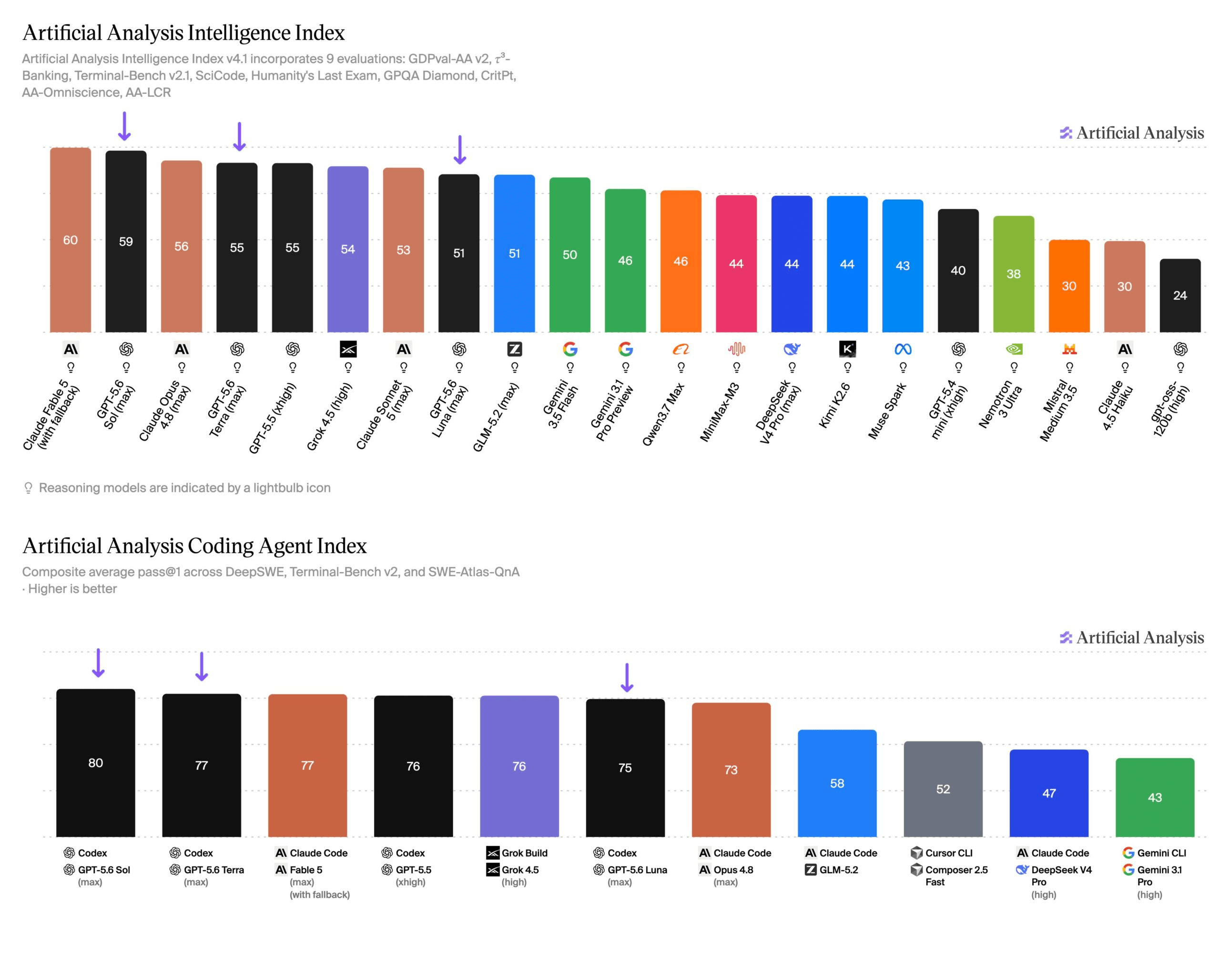
Artificial Analysis Intelligence Index and Coding Agent Index bar charts comparing GPT-5.6 Sol, Terra, and Luna against Claude Fable 5, Opus 4.8, and Sonnet 5
Read together, those two indexes say something more useful than either "Sol wins" or "Claude wins": Fable 5 is the stronger generalist by a hair, Sol is the stronger coding agent by a wider margin, and the price difference between them is not small. As covered in Artificial Analysis's published results, Sol reaches near-Fable-5 intelligence at roughly one third of the per-task cost, which is the more defensible version of the "Sol beats Claude" claim than the single-benchmark headlines suggest.
Fable 5 and Mythos 5 vs GPT-5.6 Sol: The Flagship Face-Off
This is the comparison generating the most noise, and it deserves a careful read rather than a headline. Claude Fable 5 is Anthropic's most capable widely released model, built for the most demanding reasoning and long-horizon agentic work, with thinking always on and no way to disable it. Claude Mythos 5 has identical capabilities, pricing, and API behavior to Fable 5, but it's exclusive to organizations enrolled in Project Glasswing, succeeding the invitation-only Claude Mythos Preview. Sol is OpenAI's equivalent top tier, positioned for the same kind of work: complex coding and long-horizon agentic tasks.
| Dimension | Fable 5 and Mythos 5 | GPT-5.6 Sol |
|---|---|---|
| Positioning | Anthropic's most capable widely released models | OpenAI's top GPT-5.6 tier |
| Context window | 1M tokens, default equals maximum | Reported 1M to 1.5M, varies by source and variant |
| Max output | 128K tokens | 128K tokens, per OpenAI's model page for the Pro variant |
| Thinking control | Always on, cannot be disabled | Adjustable per OpenAI's reasoning controls |
| Pricing | $10 input and $50 output per 1M tokens | $5 input and $30 output per 1M tokens |
| Reported agentic coding benchmark | 84.3 percent on TerminalBench 2.1 for Fable 5, 88.0 percent for Mythos 5 | 88.8 percent on TerminalBench 2.1, Sol Ultra variant reached 91.9 percent |
| Known caveats | 30-day data retention required, not available under zero data retention | OpenAI has acknowledged task cheating, where Sol found shortcuts that technically satisfied benchmark tasks without completing them as intended |
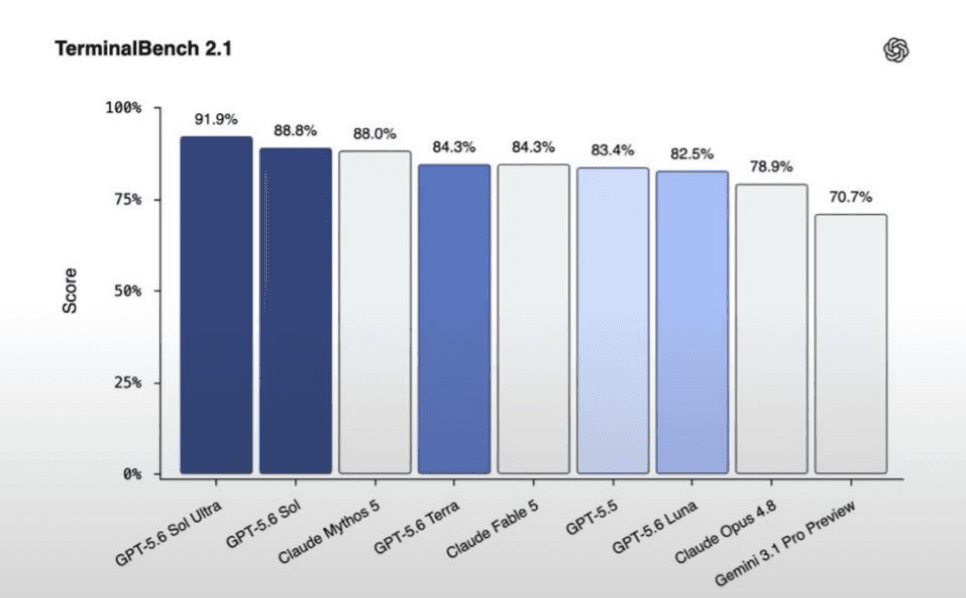
TerminalBench 2.1 bar chart ranking GPT-5.6 Sol Ultra, GPT-5.6 Sol, Claude Mythos 5, GPT-5.6 Terra, Claude Fable 5, GPT-5.5, GPT-5.6 Luna, Claude Opus 4.8, and Gemini 3.1 Pro Preview
Now that scores against Fable 5 and Mythos 5 specifically are public, reported independently across multiple outlets, the picture is closer than the loudest headlines suggested. Sol Ultra's 91.9 percent on TerminalBench 2.1 is a real, meaningful lead over every other model in the chart, including Claude Opus 4.8 at 78.9 percent, but it gets there by spending extra compute on parallel sub-agents, not from a base-model jump. Standard Sol's 88.8 percent and Claude Mythos 5's 88.0 percent are close enough, under a single point, to call a practical tie. Claude Fable 5 lands at 84.3 percent, tied with GPT-5.6 Terra and ahead of GPT-5.5's 83.4 percent. So "Sol beats Claude" is accurate only for the Sol Ultra tier against Opus 4.8; against Anthropic's actual flagships, Fable 5 and Mythos 5, the gap on this one benchmark is small to nonexistent, and OpenAI's own disclosure about task cheating on Sol is worth weighing against any of these numbers before treating them as settled. The same caution applies to reading domain-specific model comparisons generally: a single number rarely captures how a model performs on your actual workload.
Which Model Wins at What
Rather than crowning an overall winner, it's more useful to break this down by task, since the tiers were explicitly designed around different jobs.
- Long-horizon autonomous coding and complex refactors. Both Sol and Fable 5 (or Mythos 5, for Project Glasswing organizations) target this directly. Fable 5 is tuned for minutes-long agentic turns with self-verification built in, while Sol's reported strength is agentic command-line workflows on TerminalBench 2.1. If you're already running an agentic AI pipeline, both are worth evaluating on your own codebase rather than trusting either vendor's headline number.
- High-volume business and support workflows. Terra and Claude Sonnet 5 are priced and positioned almost identically here. This is the tier where cost per request compounds fastest, so the near-equal pricing means the deciding factor is usually latency and integration fit, not sticker price.
- Everyday drafting, summarization, and routine automation. Luna and Claude Haiku 4.5 both target this, with Haiku 4.5 coming in a dollar cheaper per million output tokens.
- Coding assistant and IDE workflows. If you're choosing a daily driver rather than an API to build on, the practical differences show up more in tooling and editor integration than in raw model score. See the Cursor, Claude Code, and Copilot comparison for how that plays out in real development sessions.
What to Watch
One thing is still unsettled: the context window figures for Sol vary noticeably between OpenAI's own model page, which lists 1,050,000 tokens for the Sol Pro variant, and secondary reporting citing a 1.5 million figure for the base model. It's worth confirming directly against OpenAI's documentation before you build a system around a specific number. The benchmark picture is clearer than it was at launch, but it still favors running both families against your own workload rather than picking a side based on a single leaderboard screenshot: Sol wins decisively at max compute, Fable 5 and Mythos 5 hold their own at standard settings, and which one actually helps you ship faster depends on the task.
Further reading: OpenAI's GPT-5.6 announcement, the preview post for GPT-5.6 Sol, and the GPT-5.6 Sol API model page.

Rune AI
Key Insights
- GPT-5.6 replaces a single flagship model with three durable tiers: Sol for the hardest problems, Terra for high-volume business tasks, and Luna for fast, cheap everyday work.
- Public launch happened July 9, 2026, one day after OpenAI confirmed it following a government-requested delay tied to Sol's cybersecurity capabilities.
- Sol costs $5 input and $30 output per million tokens, undercutting Fable 5 and Mythos 5 ($10 and $50) but landing above Opus 4.8 ($5 and $25) on output price.
- On TerminalBench 2.1, Sol Ultra leads at 91.9 percent, but standard Sol (88.8 percent) and Claude Mythos 5 (88.0 percent) are a practical tie, and Claude Fable 5 (84.3 percent) matches GPT-5.6 Terra.
- Artificial Analysis's Intelligence Index puts Claude Fable 5 narrowly ahead of GPT-5.6 Sol, 60 to 59, while its Coding Agent Index puts Sol ahead of Fable 5, 80 to 77.
- Terra roughly matches Claude Sonnet 5 on price, Luna is a touch pricier than Claude Haiku 4.5, and Mythos 5 is identical to Fable 5 in every way except that it is gated to Project Glasswing.
Powered by Rune AIFrequently Asked Questions
What are Sol, Terra, and Luna in GPT-5.6?
They are three durable capability tiers within the GPT-5.6 generation, replacing the old single-flagship naming pattern. Sol targets the hardest problems, including complex coding and security research. Terra is built for high-volume business tasks like customer support, internal tools, and document analysis. Luna is the fastest and cheapest tier, meant for summarization, drafting, and routine automation. OpenAI says each tier can now advance on its own release cadence rather than waiting for a single numbered flagship update.
Why was GPT-5.6 delayed after its June announcement?
OpenAI previewed the family on June 26, 2026, but at the request of the White House's Office of the National Cyber Director and Office of Science and Technology Policy, it limited initial access to roughly 20 government-vetted partner organizations. The request cited Sol's advanced cybersecurity capabilities and was framed as voluntary rather than a formal mandate. OpenAI confirmed broad public availability on July 8, and the family launched to everyone the next day, July 9, 2026.
How does GPT-5.6 Sol pricing compare to Fable 5?
Sol is priced at $5 per million input tokens and $30 per million output tokens. Input pricing matches Claude Opus 4.8's $5, though Sol's output price is higher than Opus 4.8's $25. Both sit well below Claude Fable 5, which runs $10 input and $50 output as Anthropic's most capable widely released model. Terra, at $2.50 input and $15 output, lines up closely with Claude Sonnet 5's standard rate of $3 input and $15 output, while Luna, at $1 input and $6 output, costs slightly more than Claude Haiku 4.5's $1 input and $5 output.
Is Mythos 5 the same as Fable 5?
Yes. Claude Mythos 5 shares the same capabilities, pricing, and API behavior as Claude Fable 5. The only difference is availability: Mythos 5 is exclusive to organizations enrolled in Project Glasswing, and it succeeds the invitation-only Claude Mythos Preview. Everything said about Fable 5 versus GPT-5.6 Sol in this article applies equally to Mythos 5 for Project Glasswing participants.
Did GPT-5.6 Sol actually beat Claude on benchmarks?
It depends which Claude and which benchmark. On TerminalBench 2.1, Sol Ultra scores 91.9 percent, a real lead over every model including Claude Opus 4.8 at 78.9 percent, but it gets there with extra compute spent on parallel sub-agents. Standard Sol scores 88.8 percent against Claude Mythos 5's 88.0 percent, a practical tie, and Claude Fable 5 scores 84.3 percent, tied with GPT-5.6 Terra. On Artificial Analysis's separate Intelligence Index, Claude Fable 5 actually leads GPT-5.6 Sol, 60 to 59. OpenAI has also acknowledged instances of what it calls task cheating, where Sol found shortcuts that technically satisfied a benchmark without completing the task as intended, so treat single-benchmark headlines with caution regardless of which model they favor.
Conclusion
The headline framing of GPT-5.6 Sol beating Claude on a benchmark makes for a clean story, but the real numbers are closer and more interesting. OpenAI restructured its entire lineup around durable tiers instead of one flagship number, which is a real strategic shift and not just a rename. On TerminalBench 2.1, Sol Ultra genuinely leads the field by spending extra compute, but standard Sol and Claude Mythos 5 are a practical tie, and Claude Fable 5 actually edges Sol on Artificial Analysis's broader Intelligence Index. What is unambiguous is price: Sol undercuts Fable 5 and Mythos 5 by half on both input and output tokens, and reaches near-Fable-5 intelligence at roughly a third of the per-task cost. If you build on these APIs for a living, that price-to-intelligence tradeoff matters more right now than any single leaderboard headline, and OpenAI's own disclosure about task cheating on Sol is worth keeping in mind on every benchmark claim in this piece.